Your metabolism (your body’s ability to burn calories) is constantly feeding back to you about how happy it is with your lifestyle. If you have a balanced metabolism, you will feel energised, satisfied by your food and your cravings, if any, will be psychological rather than physical. And by that, I mean above the neck and activated by an advert you’ve seen, a habitual behaviour or a conversation about a certain food, rather than actually felt in your stomach.
If follows then, that the better you can tune into your own behaviours, the better you will get to know yourself and what works for you. You have to become your own metabolic detective, constantly monitoring your hunger, energy and cravings (HEC) to see if you’re getting things right.

PLAY DETECTIVE: Get to know your own metabolism
Certain foods can cause you to throw all your good resolutions out of the window. These are called ‘trigger foods”. Thankfully, we also have something called ‘buffer foods” which we can call to the rescue when a binge threatens.
What is a trigger food?
A trigger food is something that throws your HEC (hunger, energy, cravings) out of balance, stops you achieving results and/or causes you to go on a binge on the wrong foods.
What is an example of a trigger food
Everyone is different and although we all share some baseline overlaps in what works for us, in the main, the following can be trigger foods:
Food high in fat, starch sugar and/or salt.
Think about it. When was the last time you opened a packet of buttery, sugar biscuits and ate just one. Why is this? Well, firstly, they taste good and that’s the problem. They are so highly-palatable, they make us eat more at present meal and crave more of it later. McDonalds food is a big example of this.
This is why having a “cheat meal” can lead us back down a slippery slope. There is a lot of ongoing research into this are and scientists are close to proving that when food is put together in these combinations, it triggers addictive behaviour in the brain.
That’s why you should avoid combining these foods. Think of things you like to eat, buttery toast, pasta and creamy sauces, pizza, Krispy Kreme donuts. All of these foods contain this combination.
Foods with a lot of flavour can trigger overeating. Even though we don’t want to hear it, the truth of the matter is the simpler you can keep your diet, the better your results will be. Stick to flavouring with herbs and spices and not butter, oils, soy sauces, etc
Fruits, sugar-free products, nuts, nut butters and alcohol.
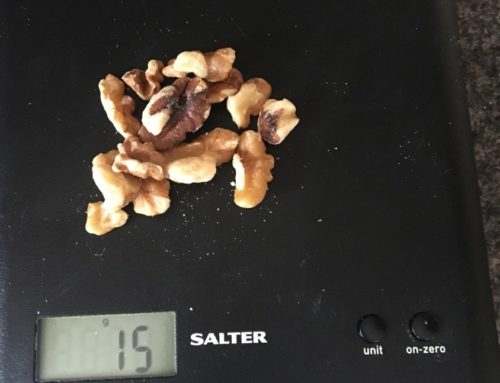
According to research, these foods can all trigger over-eating. I know myself that if I have a bag of nuts in the cupboard, I will be tempted to stick my hand in there every time I go into the kitchen.
So for me, they are a trigger. For others, nuts in small volumes may provide a healthy snack.

GO NUTS: Pecans are a trigger for me
Start to monitor your eating of these foods, because for most the represent “healthy” eating. Remember, though, that your metabolism doesn’t care whether a food is healthy or not. If you’re eating too much of a good thing, you’ll gain weight.
A limited variety diet
This can be a trigger for some people. A acquaintance of mine is a bikini athlete. She competes posing on stage in a bikini to show off her toned body. Now, in the dieting phase, they are the embodiment of an out-of-balance HEC. They live on cod or chicken and broccoli, they are miserable and wracked with cravings most of the time but they have the willpower to push through because they know they have to compete on stage half-naked so that’s what keeps them going. And they know it’s only for a short time, probably around 6 weeks.
However, literally the day after her last competition, my friend posted a picture of the pile of sugary, salty, processed carbs she was planning to binge on for the next 24 hours.
This is the affect that a limited diet can have, albeit a bit of an extreme example. When you’re presented with a wider range of food choices, you go crazy.
Message here is to vary your diet choice, but keep your prep pretty simple.
Artificial sweeteners like those found in diet drinks.
These can disrupt your normal biochemical reactions. Even though they have zero calories or sugar, the sickly sweet taste on the tongue can still cause the pancreas to produce a lot of insulin, like it would if you had actually eaten sugar.
Problem is, there is no sugar in the bloodstream. In this case, the released insulin which is supposed remove the sugar and send it into the liver and muscles for storage, an actually lower your blood sugar. The brain then perceives a low blood sugar threat and can increase hunger and cravings in some people a result. So, again, if you insist on continuing to drink diet drinks take notice of your HEC and how it is affected.
Dairy and gluten
A lot of research is pouring into these areas at the moment. If you have been with me for a long time and read my posts, you’ll remember that some science has shown that a protein in gluten can cause your body to attack your own thyroid, which is a disaster for your metabolism. Those sensitive to gluten can also suffer digestive issues, which again, is not ideal for weight loss. Some people also struggle with dairy too. If you are suffering digestive discomfort and bloating, keep a food diary and see which foods correlate with it. Obviously, if you are affected by these foods this can throw your HEC out of check.
WHAT IS A BUFFER FOOD?
A buffer food is something you can call on when you’re wracked by cravings that will just scratch that itch, yet stop you going on an all-out binge
By definition, then, a buffer food is something that doesn’t trigger a full-on binge. Instead, it just keeps you sane and distracts you from thinking about and indulging in the really bad stuff that does.
For example, if I have a sweet craving a nice crispy Braeburn apple will often do it for me. I might also have a couple of tablespoons of natural yoghurt with a drizzle of honey if I feel like I need sugar.
If I have a bread craving, I’ll make a coconut flour pancake with two eggs and that will get me over it.
Or for some people, a couple of squares of high cocoa content (over 75%) chocolate can stop you breaking into a family size bag of M&Ms.
Some people can have a single glass of red wine with dinner and that will keep them satisfied and stop them reaching for dessert, cheese and biscuits etc.

The best way to judge a buffer food is to ask yourself: “Can I control my intake of this food?” If the answer is yes, then this is a buffer for you.
A food that you can eat a small amount and feel satisfied by is a buffer food. But this is not an open invitation to binge on it. You don’t want a buffer food to turn into a trigger food.
By the way, Cocoa powder, or raw cacao (NOT DRINKING CHOCOLATE!!) is an excellent craving-queller. Just mix a tablespoon of it in water to make a paste and drink it down, maybe add a little cinnamon to help stabilise blood sugar.
Summary
There is no hard and fast rule here. What causes some people to crave will be another person’s buffer and vice-versa. I have no interest in pizza or Chinese food, but the thought of some walnut bread dipped in olive oil makes me want to drool. Start to get to know yourself and build a picture of who you are and how you tick and you will soon have a blueprint to get yourself lean and keep yourself lean for life.